
Start with the space, not a material acronym.
A tensile membrane enquiry becomes more useful when it explains how the space will be used. Shade over an open public area, a weather cover for a loading point and a light-filled enclosed roof do not begin with the same requirements. Write down the purpose of the cover, the area to protect and the parts of the site that need to stay open.
Then describe daylight, ventilation, weather exposure and any relationship with existing buildings. A material comparison can help organize these questions, but it does not replace a project specification or an engineering review. The appropriate grade, support arrangement and performance evidence need to be considered together.
Understand the difference between fabric and film.
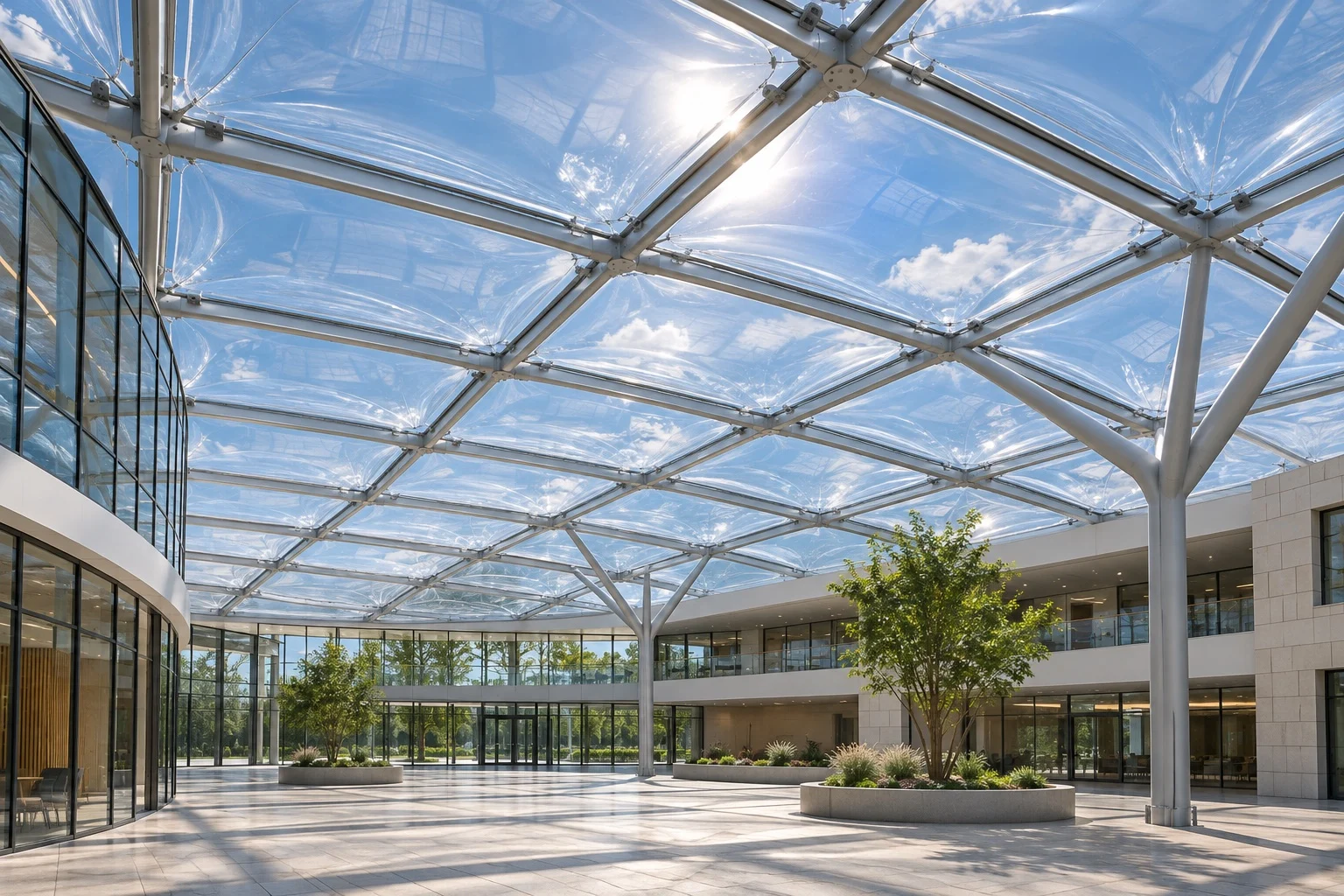
PTFE-coated fiberglass is a woven glass-fiber fabric with a PTFE coating. PVC architectural membranes are reinforced coated fabrics, with the proposed reinforcement and surface finish forming part of the material specification. ETFE is a film; its roof arrangement may use a supported single layer or a multi-layer cushion system.
These differences affect what needs to be discussed. For a coated fabric, ask about the selected grade, panel fabrication, seams, edges and connection details. For an ETFE cushion proposal, include the air equipment, controls, power and operating responsibilities in the discussion. A material label on its own does not define the complete supply package.
Compare the environment below the roof.
Explain what people or operations below the roof require. Is filtered daylight desirable, or does the space need a more transparent enclosure? Does a glazed facade or neighboring roof create an interface that must be coordinated? How will rainwater leave the roof and reach the surrounding drainage system?
Where solar gain, glare, acoustics or thermal conditions matter, state the requirement and ask how the proposed system will be assessed. Do not assume that every product in a material family has the same optical, thermal or acoustic behavior. The layer arrangement, surface treatment and complete construction can change the answer.
Review geometry, interfaces and access.
Show support positions, clearances and any zones where foundations or columns would conflict with the site. Identify the membrane, steelwork, connection and foundation designers, and agree how information will pass between them. A change at one interface may affect several packages.
Plan access for construction and maintenance while the layout can still be adjusted. Ask how panels or equipment can be inspected and, if necessary, replaced. These operational questions can be easier to resolve before a visually preferred form becomes fixed.
Ask for evidence that matches the proposed grade.
A general brochure can explain a material family. Procurement requires the proposed grade, applicable test evidence and a clear relationship between the documents and the supplied system. Confirm which local requirements apply and who is responsible for the relevant design review or approval.
Keep the comparison practical: record the required use, daylight objective, enclosure type, material proposal, interfaces, maintenance approach and scope included in the offer. Avoid substituting an unverified design-life number, certification badge or cost-per-area claim for that information.
Turn the comparison into an enquiry.
Share a marked plan, photographs, approximate dimensions and the project location. State whether you need design coordination, fabrication and supply, installation support or a combination. Explain the decisions already made and the questions that remain open.
Use the PTFE, ETFE and PVC system pages to start the material discussion, then connect the choice to the relevant application and service scope. Material availability and technical properties should be confirmed for the actual project package.
Related project resources
Further material reading
Published material information helps explain system choices. Check the proposed grade and the requirements of the actual project.
- AGC: an architectural ETFE film application
- Birdair: PTFE fiberglass material information
- Birdair: PVC membrane material information